
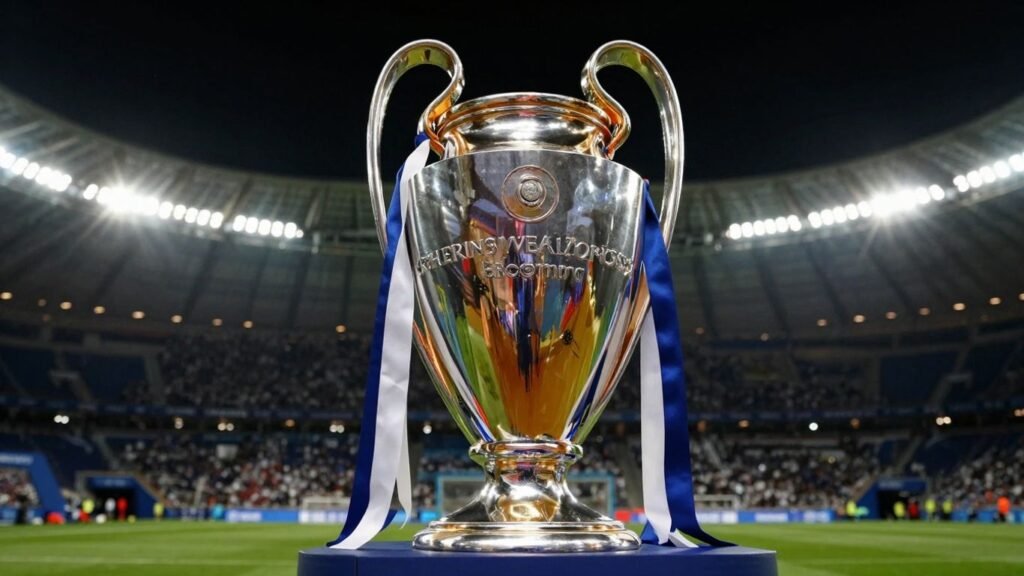
The 2026 Champions League season is almost here, and things are looking a bit different this year. With a new format and a packed schedule, it’s easy to get lost in all the details. Don’t worry, though. We’ve broken down everything you need to know about the upcoming champions league 2026, from how the games will work to when the big matches are happening. It’s going to be a wild ride.
Key Takeaways
- The champions league 2026 season features a new league phase with 36 teams, replacing the old group stage.
- Teams will play eight different opponents, with the top eight advancing directly to the Round of 16.
- Budapest’s Puskás Arena is set to host the champions league 2026 final on May 30.
- Six English clubs will participate, a first for the competition, thanks to their league performance and a Europa League win.
- The preliminary and qualifying rounds kick off in July 2025, with the main league phase starting in September 2025.
Understanding The Champions League 2026 Format
Alright, let’s break down how this whole Champions League thing is going to work for the 2026 season. It’s a bit different from what we’re used to, so paying attention now will save you a headache later. UEFA has shaken things up, and it’s not just a minor tweak; it’s a whole new ballgame.
The New League Phase Structure
Forget the old group stages. We’re now in the second year of the league phase, and it’s a big one. Instead of a few small groups, all 36 teams are thrown into one massive league table. Each team plays eight different opponents, with half of those games at home and half away. It’s a marathon, not a sprint, and consistency is key. The top eight teams in this league phase go straight through to the knockout rounds, no messing about. For teams finishing between 9th and 24th, it’s a play-off round to earn their spot in the next stage. And for the teams that finish 25th or lower? Well, they’re out, with no safety net in the Europa League. It’s a tough system, but it means every game really counts.
Qualification Pathways
So, how do you even get into this league phase in the first place? It’s a mix of automatic spots and qualifying rounds. Most teams get in based on how they finished in their domestic leagues the previous season. The winners of the Champions League and Europa League also get automatic berths. Then there are the qualifying rounds, which happen earlier in the summer, where teams battle it out for the remaining slots. It’s a bit of a scramble, and some teams might find themselves playing a lot of games before the main event even kicks off. The 2025–26 UEFA Champions League league phase will feature 36 teams, all vying for those coveted spots.
Seeding and Home Advantage
This is where things get interesting for the later stages. The final rankings in the league phase aren’t just about who qualifies; they also affect your seeding for the knockout rounds. The teams that finish in the top four spots after the league phase get a nice little perk: they’ll play the second leg of their quarter-final tie at home. Even better, if you finish first or second, you get to play the second leg of your semi-final at home. It’s a real advantage, especially in tight matches. However, if a seeded team gets knocked out, the team that beat them takes over their seeding position. So, even if you’re a top seed, you can’t afford to slack off.
The new format means that a strong showing in the league phase can set you up nicely for the business end of the competition. It rewards consistent performance over the initial eight matches, giving top teams a potential edge in crucial knockout ties.
Key Dates For The Champions League 2026 Season
Alright, so you want to know when all the action is happening for the 2026 Champions League? It’s a long road, starting way back in the summer and wrapping up in late spring.
Preliminary and Qualifying Rounds
Things get going pretty early, actually. The very first matches, the preliminary and qualifying rounds, kick off in July 2025. These early stages are where teams from less prominent leagues battle it out for a shot at the big time. It’s a bit of a grind, with multiple two-leg ties to get through.
- First Qualifying Round: July 8/9 and 15/16, 2025
- Second Qualifying Round: July 22/23 and 29/30, 2025
- Third Qualifying Round: August 5/6 and 12, 2025
League Phase Schedule
Once the dust settles from qualifying, the real giants enter. The draw for the new-look League Phase happens on August 28, 2025. Then, the actual matches get underway in September 2025 and run through January 2026. Remember, with the expanded format, each team plays eight games, and they won’t face clubs from their own country during this phase.
Here’s a look at the League Phase matchdays:
- Matchdays 1-2: September 16-18, 2025
- Matchdays 3-4: September 30 – October 1, 2025
- Matchdays 5-6: October 21-22, 2025
- Matchdays 7-8: November 4-5, 2025
- Matchdays 9-10: November 25-26, 2025
- Matchdays 11-12: December 9-10, 2025
- Matchdays 13-14: January 20-21, 2026
- Matchdays 15-16: January 28, 2026
Knockout Stage Timeline
After the League Phase, things really heat up. The teams that finish 9th through 24th will enter a Knockout Play-off round in February 2026. The winners of those ties join the top eight teams who automatically qualify for the Round of 16. From there, it’s a straight knockout format all the way to the final. The big show, the Champions League Final, is set for May 30, 2026, in Budapest.
- Knockout Round Play-offs: February 17-18 and February 24-25, 2026
- Round of 16: March 10-11 and March 17-18, 2026
- Quarter-finals: April 7-8 and April 14-15, 2026
- Semi-finals: April 28-29 and May 5-6, 2026
- Final: May 30, 2026
Keep in mind that these dates are always subject to change. UEFA sometimes shuffles things around, so it’s always a good idea to double-check closer to the time, especially if you’re planning any travel.
The Road To The Champions League 2026 Final
So, you’ve followed the new league phase, seen who qualified, and now you’re wondering how we get from that to the big show. It’s a journey, for sure, and this year, the destination is a pretty special place.
Budapest’s Puskás Arena Hosts The Final
Mark your calendars, folks! The 2026 Champions League final is set to take place on Saturday, May 30, 2026, at the Puskás Arena in Budapest, Hungary. This stadium is no stranger to big European nights, having hosted the Europa League final a couple of years back, but this will be its first time staging the biggest club match in European football. It’s going to be a historic occasion for Hungarian football.
Knockout Play-Offs Explained
After the dust settles from the league phase, things get serious. The teams that finish between 9th and 24th in the league standings will enter a knockout play-off round. This is a new addition, designed to give more teams a chance to advance and add extra drama. Think of it as a second chance saloon for those just outside the automatic qualification spots for the Round of 16.
Here’s how it generally works:
- Teams finishing 9th-16th will be seeded.
- They will play against teams finishing 17th-24th.
- The first leg is played at the home of the lower-ranked team.
- The winners of these two-legged ties will then progress to the Round of 16.
Path to the Round of 16
Getting to the Round of 16 is the first major hurdle in the knockout stages. The teams that finish in the top eight of the league phase automatically secure their spot here. They get a bit of a breather, avoiding the play-offs. The remaining eight spots are filled by the winners of the knockout play-offs we just talked about.
So, the path looks like this:
- League Phase: Finish in the top 8 for direct qualification to the Round of 16.
- Knockout Play-Offs: For teams ranked 9th-24th, win your tie to reach the Round of 16.
- Round of 16: The final 16 teams battle it out in two-legged ties.
The journey from the league phase to the final is a marathon, not a sprint. Each stage presents unique challenges, and teams will need consistency and nerve to make it all the way to Budapest. It’s where dreams are made and broken, all on the road to lifting that famous trophy.
Teams To Watch In Champions League 2026
Defending Champions and Top Seeds
Paris Saint-Germain are heading into the 2026 Champions League season as the reigning champs. They snagged their first-ever title last year, so you know they’ll be looking to defend it. As the Champions League title holders, they’re automatically placed as the top seed in Pot 1 for the league phase draw. This gives them a bit of an advantage right out of the gate, meaning they’ll likely face a slightly easier path in the initial stages. Keep an eye on them, they’ve got the momentum and the confidence.
English Clubs’ Increased Representation
This season sees a notable boost in English representation, with six clubs making it into the league phase. This is partly thanks to England’s strong performance in UEFA coefficient rankings and Tottenham Hotspur winning the Europa League last season. So, alongside the usual suspects like Liverpool, Arsenal, Manchester City, and Chelsea, we’ll also see Tottenham and Newcastle United flying the English flag. It’s going to be interesting to see how this increased presence impacts the competition overall.
Potential Contenders From Across Europe
While PSG are the team to beat, the field is wide open. Real Madrid and Bayern Munich are always strong contenders, boasting rich histories in this tournament. You can never count out teams like Barcelona and Juventus, who are consistently competitive. From Italy, Inter Milan and Napoli showed great form last season. And don’t forget about clubs like PSV Eindhoven from the Netherlands or Benfica from Portugal, who often surprise. The expanded league phase means more matchups, and with 36 teams involved, there are plenty of dark horses waiting to make their mark.
Here’s a look at how many teams from the top associations qualified:
| Association | Teams | Notes |
|---|---|---|
| England | 6 | +1 (EPS) +1 (EL) |
| Italy | 4 | |
| Spain | 5 | +1 (EPS) |
| Germany | 4 | |
| France | 3 |
The new league phase format means every match counts. Teams will face eight different opponents, playing two games against teams from each of the four pots – one at home, one away. This structure really tests a team’s consistency over a longer period, and finishing high up the table brings real benefits for the knockout stages, like home advantage in later rounds.
Navigating The Champions League 2026 Draws

Alright, so you’ve got your team, you know the dates, and you’re ready for the big games. But before all that kicks off, there’s the small matter of the draws. It’s where the drama really starts, figuring out who plays who and when. This year, with the new league phase format, things are a bit different, but the core idea of pots and pairings is still there.
League Phase Draw Details
The big one, the league phase draw, happens on August 27th. This is where all 36 teams find out their eight opponents for this stage of the competition. It’s not just a random grab-bag, though. Teams are sorted into four pots based on their UEFA coefficient, meaning the top teams are generally kept apart in the initial seeding. You can’t play teams from your own country, and you’ll only face a maximum of two clubs from any single nation. Each team plays two games against clubs from each of the four pots – one at home, one away. It’s a computer system that does the heavy lifting here, making sure everything’s fair and square.
The draw is a complex process, with automated software ensuring that each of the 36 teams is assigned eight unique opponents, balancing home and away fixtures while respecting national association restrictions.
Knockout Phase Draw Dates
Once the league phase wraps up and the dust settles, the focus shifts to the knockout rounds. The top eight teams automatically go through to the Round of 16. But for those finishing between 9th and 24th, there’s a playoff round to decide the remaining spots. The draw for these playoffs usually happens shortly after the league phase concludes, typically in late January or early February. After that, the Round of 16 draw will set up the path to the final. Remember, from this point on, all ties are seeded based on league phase performance, so the higher-ranked teams get the advantage of playing the second leg at home.
Understanding Pot Allocations
Pot allocations are pretty key to how the draws unfold. They’re based on a team’s UEFA coefficient, which basically reflects their performance in European competitions over the last few seasons. Pot 1 is usually reserved for the league champions and the winners of the previous Champions League. The subsequent pots are filled in descending order of coefficient. This system aims to distribute the strongest teams across the different groups and, in the new league phase, across the different sets of opponents each team will face. It’s a way to try and keep things competitive right from the start, though upsets are always part of the fun. You can check out the official UEFA coefficient rankings to get a better idea of how teams are seeded.
The Road to Budapest
So there you have it, a look at what’s coming up for the 2025-26 Champions League season. It’s a big year with the new league phase format still settling in and a new champion looking to be crowned. The final is set for Budapest, and you can bet teams will be fighting hard all season long to get there. It’s going to be a wild ride, so buckle up and enjoy the football!
Frequently Asked Questions
What’s new with the Champions League format this year?
The Champions League has a new look! Instead of old-style groups, there’s now one big league with 36 teams. Each team plays eight different games against eight different opponents, some at home and some away. It’s a bit like a super league before the real knockout rounds begin.
How do teams qualify for the knockout rounds?
It’s a bit different now. The top 8 teams in the league automatically move on to the next stage, called the Round of 16. Teams that finish between 9th and 24th place have to play an extra playoff game to try and earn their spot in the Round of 16. If you finish 25th or lower, your Champions League journey is over for the season.
When and where is the 2026 Champions League Final?
Get ready for the big game on May 30, 2026! This year’s final will be held in Budapest, Hungary, at the Puskás Arena. It’s the first time this stadium will host the biggest club match in Europe.
Are there more English teams in the Champions League this season?
Yes, there are! For the 2025-26 season, England has six teams competing. This is because their teams have performed really well in European competitions over the past few years, earning them an extra spot.
When do the qualifying rounds start?
The journey to the Champions League begins early! The very first qualifying matches kick off in July 2025, long before the main competition starts in September. These early rounds involve teams from countries that don’t automatically get a spot in the league phase.
How does the draw work for the league phase?
The draw for the league phase happens in August 2025. All 36 teams are put into one big pot, and then they are drawn to play their eight matches. A key rule is that teams won’t play against other clubs from their own country during this stage.